







What is Cubism and where did it come from?
Cubism is without a doubt one of the most important art movements of the 20th century. Where Impressionism started stepping away from the ambition of objectively representing the real world, Cubism took the whole notion and threw it out the window, breaking the glass in the process.
While not many artists persisted with the style throughout their careers it has been a stepping stone or gateway drug 😉 to further experimentation for many. The radical break that Cubism allowed became a door wide open to continue exploring ideas further and further away from representative art, all the way to complete abstraction. It is, however, worth remembering that Cubism itself never became a fully abstract style, no matter how many different viewpoints you can see in a Cubist painting they are still viewpoints of a real object you can recognize.
Here you can look at Georges Braque, Houses at L’Estaque painting created in 1908, now owned by Kunstmuseum Bern, Bern, Switzerland.
It is broadly agreed that Cubism started in 1908, with the works by Pablo Picasso and Georges Braque. They drew inspiration from many sources and on their way to Cubism created works in other style such as Impressionism, Symbolism, or Fauvism. Paul Cézanne in some ways could be called the grandfather of the style, as his works exhibited in Paris in 1907, a year after his death, were one of the major sources of inspiration. Yet another inspiration was Iberian sculpture and African art.
The term Cubism is thought to have originated from a comment by an art critic Louis Vauxcelles, who described Braque’s landscapes from 1908 as reducing everything to “geometric outlines, to cubes”. While this offhand comment is a great simplification, it is exactly the kind of simplification our minds love, so it caught on.
Analytical and Synthetic Cubism
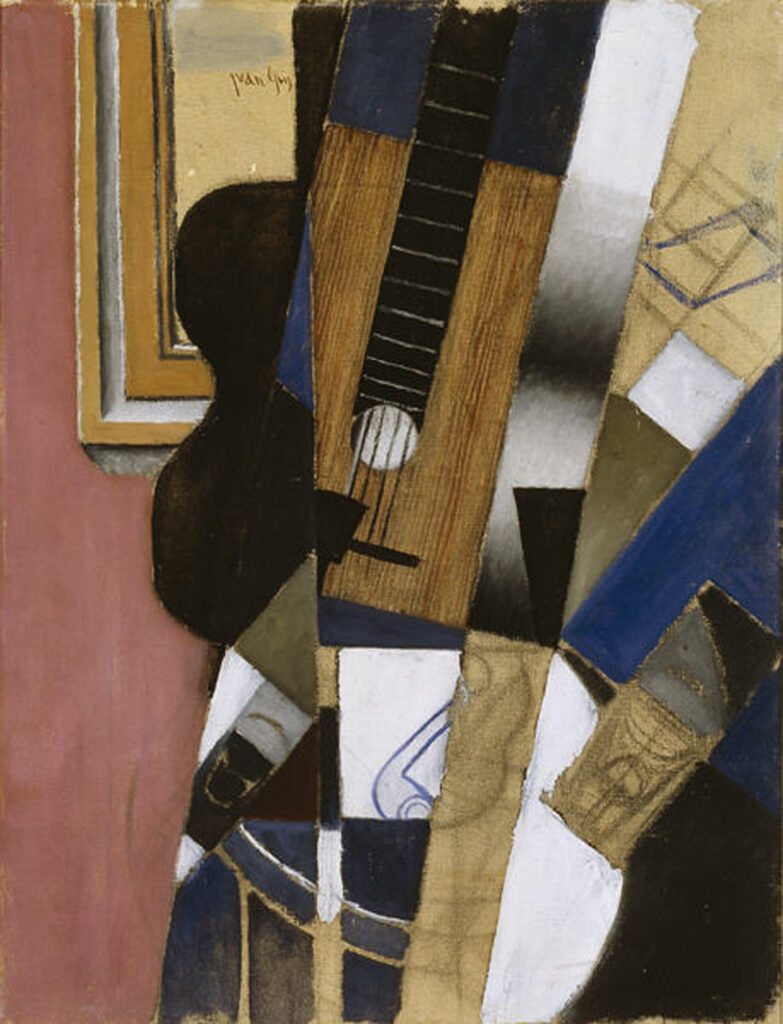
Cubism is typically divided into two phases: Analytical and Synthetic. The Analytical Cubism phase lasted from 1908 to 1912 and is characterized by a limited color palette, that allowed the artists to focus on the object. They would show multiple viewpoints of the object within the painting radically breaking with the ideal of linear perspective that has been the norm since the Renaissance. It feels like the artists are trying to explode the object onto the canvass, to accept the two-dimensionality of it and unravel the three-dimensional objects onto it to achieve a new level of order.
Here you can look at Georges Braque, La Guitare painting created in 1909-1910, now owned by Tate Modern, London, United Kingdom.
The Synthetic Cubism phase started in 1912 and “officially” came to an end in 1914 with the beginning of World War I. That of course did not mean Cubism ceased then, it was a style continued and adopted by new painters, but the initial exploration into the possibilities of the style was done by then and certain foundations have been agreed. Synthetic Cubism adopts a broader palette with many vivid colors, often used as accents. Painters abandon any illusion of shading but also simplify the forms, we can see that the two-dimensionality of the canvass now takes precedence and objects have to be simplified to conform to it. In this phase, artists also started experimenting with collage.
 10 lessons
 18 masterpieces
 Certificate of completion


 Hide
Hide


,_oil_on_canvas,_73_x_59.5_cm,_Kunst_Museum_Bern.jpg)
